

From the Archives: Microtubules, Anesthetics, and Quantum Consciousness
A paper lightly exploring the newest frontier in psychology – quantum mechanics – and a coinciding theory of consciousness – Orchestrated Objective Reduction theory.

This paper was written for my psychology of consciousness class in Fall of 2024. It has undergone no revisions since then. Its purpose is to demonstrate the findings made by Roger Penrose and Stuart Hameroff
Microtubules, Anesthetics, and Quantum Consciousness
Adam-Dylan
Psych 3502 – Psychology of Consciousness
Professor Leslie Burton
October 21st, 2024
Microtubules and quantum consciousness
It was proposed that the hard questions of consciousness involve finding correlations between brain processes and the phenomenon of consciousness. Decades of research and technological evolution shed light on the true complexity of the functions of our cognition and its relation to consciousness. Hundreds of theories spanning fields of neuroscience, biology, evolution, psychology, and sociology have attempted to explain the phenomenon of consciousness: what it means to be, what it’s like to be, how it is we are — conscious. A recent breakthrough in the understanding of anesthetic effects on the brain collides with the newest frontier of a previously unrelated field in psychology, quantum physics.
It was first speculated by an anesthesiologist and physicist that the brain has the capability for non-algorithmic based computing, also known as quantum computing. For this to be possible, a place within the brain must be able to maintain quantum coherence; meaning a state where electrons, protons, or atoms exist in multiple states simultaneously. The quantum state is defined by the features of superposition, that of existing in multiple states simultaneously; and of phase relations, the fixed alignment of the wave-functions of different particles with each other. For this to be possible, the extreme fragility of quantum coherence must be isolated from environmental disturbances, such as observation, to maintain this quantum state. Stuart Hameroff suggests that the tiny tube-like proteins found in almost all cells of the body, including neurons, are reasonably isolated and stable for such a process to go on. These tube-like proteins are known as microtubules.
These microtubules are cylindrically shaped with a spiral lattice, allowing for ‘helical macroscopic “quantum highways” … suitable for topological quantum computing’ (Hameroff, 2012, as cited in Blackwell & Troscianko, 2024, p. 142). The assumption that these microtubules have anything to do with consciousness was first suggested in a study investigating the possible mechanisms of anesthesia by Allison & Nunn (1968). It is found that numerous cellular systems are affected by general anesthetics, with cytoplasmic microtubules being found in all these systems. It is further suggested that “microtubular proteins are also susceptible to reversible depolymerization by anæsthetics”, however, “how this depolymerization results in narcosis is not yet clear, but one possibility (suggested by the abundance of microtubules in neurons) is that microtubules participate in nerve-impulse transmission (Allison & Nunn, 1968). Over half a century later, a groundbreaking study on rats uncovered an integral link between microtubules, anesthetics, and consciousness.
In 2024, a team of researchers began their study linking anesthetics with microtubules, which I will now refer to as MTs. Epothilones, a drug treatment for cancer that stabilizes MTs, is differentiated from older MT stabilizers by their heightened efficacy for penetrating the blood-brain barrier and affecting both the brain and the spinal cord. By administering this microtubule stabilizer on rats, this experimental group was compared to a control group through a latency to loss of righting reflex (LORR). The LORR latency was recorded when the rat was fully unconscious, as assessed by turning on its back, and if it failed to place all four paws back on the ground within 30 seconds. The anesthetic was administered in all rats before the MT stabilizer was administered and after the LORR latency was recorded, to reduce data variability accounting for the induced stress of epothilone injection. The results of this experiment found that the average LORR latency increased after the epothilone injection (Khan et al., 2024). This result suggests that rats administered with MT stabilizers were able to return to a conscious state quicker than rats that were not administered with MT stabilizers. This makes MTs a plausible action site for anesthetics, thus linking MTs with consciousness. The authors of this experiment comment upon these implications for competing theories of consciousness. They suggest that the results “are potentially consistent with classical models of consciousness, but they represent a more stringent test of these MT-based models, because while the classical models are agnostic about MTs as a functional anesthetic target, the MT-based models specifically predict that directly disrupting the physical state of MTs should contribute to loss of consciousness” (Khan et al., 2024). They go on to say, “Overall the Orch OR theory, in which MTs mediate anesthetic action, has more explanatory power, biological connection, and experimental validation than the classical theories” (Khan et al., 2024).
The theory proposed by physicist Roger Penrose in collaboration with anesthesiologist Stuart Hameroff suggests that consciousness emerges from the quantum coherence in microtubules. This theory, known as Orchestrated Objective Reduction (Orch OR), best explains what Penrose lists as the three main problems of understanding consciousness: The unitary sense of self; free will; and the effects of anesthesia (Blackwell & Troscianko, 2024, p.142). As quoted by the authors in Khan et al. (2024), the results of the experiment “corroborate the plausibility of the MT-based quantum physical model of consciousness and the hypothesis that isoflurane could contribute to abolishing consciousness by interacting with an entangled state of MT”. Furthermore, “these results support that the MT vibrational state and resultant electromagnetic field can interact systematically with the membrane voltage that we know is closely related to mental function and behavior and again that this coupling can traverse the physical gap between neurons” (Khan et al., 2024). The results of this study and the comments of the authors suggest that “The physical substrate of consciousness in the brain must be a nontrivial macroscopic quantum state”, its implications declaring: “(1) the existence of a macroscopic quantum entangled state in the brain, [and] (2) that this quantum brain state is likely related to consciousness and cognitive functioning, (Khan et al., 2024). What this opens is a methodology of understanding consciousness as a quantum phenomenon, suggesting that our unified sense of self as well as free will do not have properties stemming from classic physics, but they manifest from a quantum origin. The validity given to Orch OR by this study integrates the problems of consciousness into the mechanics of quantum physics.
The fundamental principles of Orchestrated Objective Reduction are alluded to in its name. As proposed by Penrose and Hameroff, consciousness emerges from quantum processes within the brain’s microtubules. A key principle of these mechanics is the collapse of wavefunctions into particles, a phenomenon that occurs when the superimposed state of particles grows too far apart and collapse into one possibility or the other. In Orch OR, consciousness can be stated as a process that is “gravitational but nonlocal in nature”, ‘creating a large-scale link between things in a widely seperated area’ (Blackwell & Troscianko, 2024, p.141). What he means by gravitational is the idea that quantum states collapsed not through environmental interference or observation, but through a certain threshold of gravitational instability leading to the non-computable collapse of the wave function. He deems this threshold the Penrose Threshold, from which consciousness emerges. He suggests that when these collapses happen within the brain’s microtubules in an organized manner, they contribute to ‘our causal selection of our particular actions and perceptions” (Hameroff 2022). Orchestrated, meaning coordinated and controlled, suggest the nature of these collapses to be induced by our biological processes. Objective reduction, referring to the collapse of the wave function into a singular possibility, is the key component of consciousness, a phenomenon that arises if and when they happen in a controlled and coordinated manner — hence the theories name, orchestrated objective reduction.
The problem that Penrose into the realm of a quantum conscious and his Orch OR theory is within the troublesome explanatory gap that arises between actual experience and conscious perception of it. First, he explains the problem of going from classical physics to quantum, or vice versa. He explains that superposed states are possible — quantumly — but either one or the other must be the case — classically (Blackwell & Troscianko, 2024, p.140). To solve this, his suggestion that the isolated system of the brain’s microtubules is capable of quantum coherence strongly links consciousness with the mechanics of quantum physics. That includes nonlocality (particles being linked across vast distances unexplained by classical physics), quantum indeterminacy (systems existing in a superposition of states until a quantum collapse occurs) and non-algorithmic computing (superposition collapsing into one specific state). These quantum implications answer a few hard problems for understanding consciousness: The unitary sense of self; free will; and the effects of anesthesia. He suggests that the unitary sense of self arises from the non-locality of quantum processing. The quantum processing of information on a global scale allows for a single, unified conscious experience despite the underlying processes being distributed across neurons. Our sense of free-will comes from quantum indeterminacy. Instead of consciousness being completely determined by previous states, the mind instead could exert influence over which quantum states collapse, creating a conscious decision-making process that is not bound by strict determinism. The effects of anesthesia, specifically the abrupt transitions from unconscious to conscious or vice versa, may be explained as quantum state reduction.
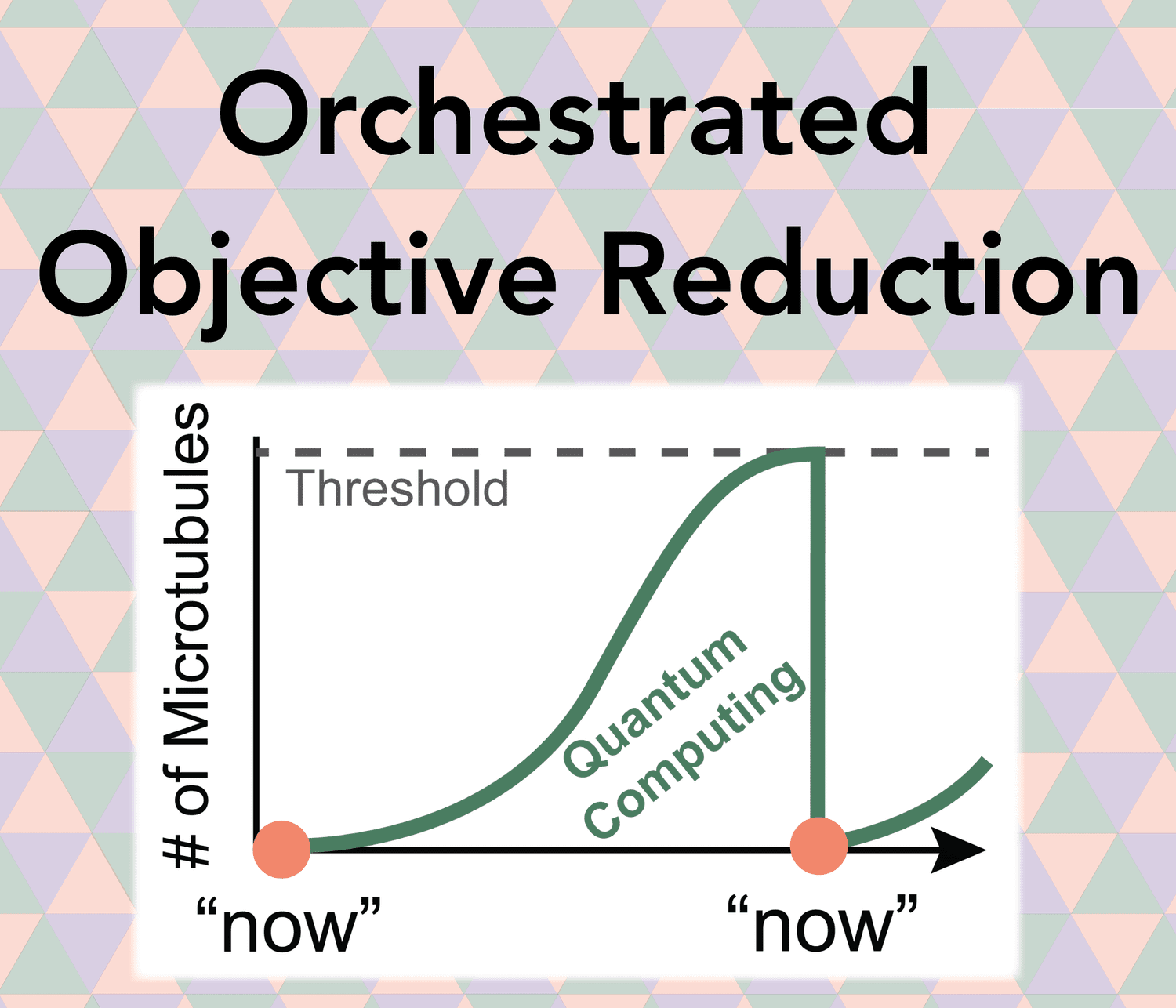
As the quantum events and the collapses proposed by Orch OR are not random, this suggests the presence of an invisible agency (Blackwell & Troscianko, 2024, p.142). This invisible agency can be called consciousness, as this invisible agent is responsible for the orchestrated collapse of wave functions that give rise to the unitary awareness of the self and the self-efficacy of decision making, which is considered fundamental to consciousness. As the universe operates on a quantum level, this suggests that consciousness isn’t just a product of the brain’s classical processes, but that it’s intertwined with the very fabric of the universe on a quantum level. The true hard question of consciousness as proposed by Blackwell & Troscianko, (2024, p.28) — that being, how physical processes give rise to subjective experience — can now be understood as a path that quantum physics may hold an answer to. However, part of the problem still remains. What is the mechanism that links microtubule behavior to qualia, our subjective experiences of perception? In what ways can we test the claims of Orch OR? — that being how and why our invisible agent operates. One thing that we can claim with sincerity is that quantum processing within the brain is a truly distinctive trait separating natural intelligence with artificial intelligence. Perhaps what links humanity to the rest of nature isnt intelligence, or divine stewardship, but the simple fact that we are all a part of life. With this new understanding in mind, hopefully new breakthroughs will bring us closer to unlocking life’s final mystery — understanding consciousness.
References
Allison, A. C., & Nunn, J. F. (1968). Effects of general anæsthetics on microtubules: A possible mechanism of anesthesia. The Lancet, 292(7582), 1326-1329. https://doi.org/10.1016/S0140-6736(68)91821-7
Blackwell, S., & Troscianko, T. (2024). Psychology of consciousness: An introduction (4th ed.). Routledge
Hameroff S (2022) Consciousness, Cognition and the Neuronal Cytoskeleton – A New Paradigm Needed in Neuroscience. Front. Mol. Neurosci. 15:869935. doi: 10.3389/fnmol.2022.869935
Khan, S., Huang, Y., Timuçin, D., Bailey, S., Lee, S., Lopes, J., Gaunce, E., Mosberger, J., Zhan, M., Abdelrahman, B., Zeng, X., & Wiest, M. C. (2024). Microtubule-stabilizer epothilone B delays anesthetic-induced unconsciousness in rats. eNeuro, 11(8), Article ENEURO.0291-24. https://doi.org/10.1523/ENEURO.0291-24.2024